
Before they arrive, let them feel somewhere else.
A retreat begins long before the journey. It begins in the quiet moment someone sees your destination, imagines themselves there and wonders whether this is the experience they have been waiting for.
I create considered, cinematic yoga retreat websites that turn that first feeling into understanding, confidence and a clear next step.
A retreat is not simply a date in a calendar.
It might be a few mornings beside the sea. A week of practice beneath mountain skies. Time to breathe without watching the clock. Whatever your retreat offers, the website needs to communicate its character before a prospective guest has even opened the itinerary.
Beautiful photography can create interest. But interest alone rarely answers the questions that stand between curiosity and an enquiry. Guests need to understand the teachers, the setting, the daily rhythm, the accommodation and the investment. They need to feel welcomed rather than pressured.
That is the work of a well-designed retreat website: to hold the emotion and the information together, allowing each to strengthen the other.
“The page should feel less like a brochure, and more like the first few minutes of arriving.”
Give people a place to imagine themselves.
A beautiful retreat photograph is more than decoration. It can communicate warmth, scale, landscape and the pace of the experience. When placed alongside specific, honest writing, it helps visitors picture not only where they will be, but how they might spend their days.
I use imagery to establish a sense of place, then build a thoughtful narrative around the practices, people and practical details. A retreat in the Polish mountains should not look or sound like a coastal escape in Portugal. Your distinctive setting and approach should guide the design.
Rather than filling every space with promotional language, the page should leave room for anticipation. Quiet moments, generous typography and a carefully chosen sequence of images can make the experience feel more tangible.
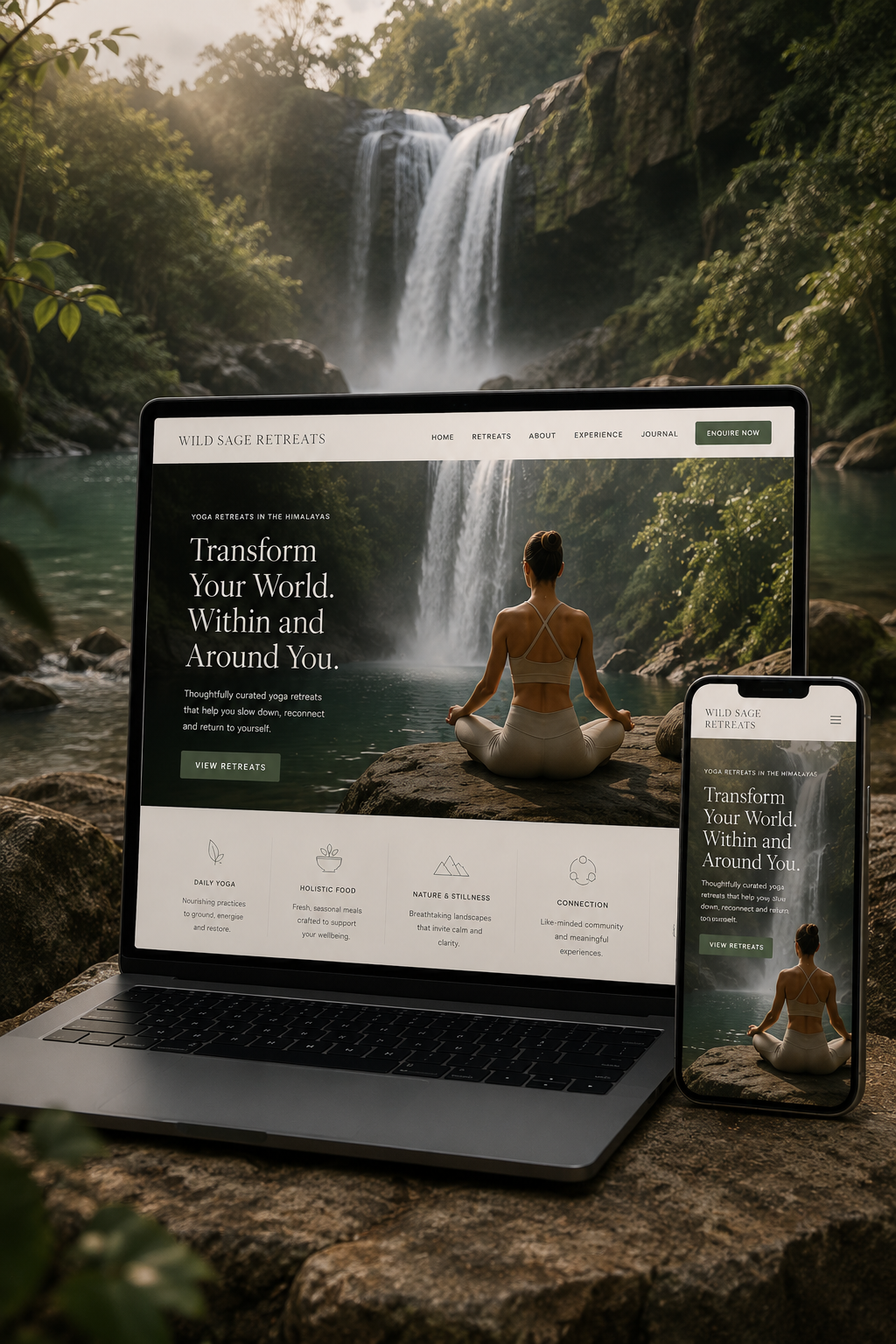
What your guests need to know before they say yes
The most persuasive retreat pages answer real questions with warmth and precision. Each part of the experience should be easy to find, without requiring visitors to chase information across emails, social posts or PDFs.
These six foundations are where beautiful presentation becomes genuinely useful.
The destination
Where guests will stay, how the place feels, what the surroundings offer and how to travel there.
The experience
Yoga styles, meditation, workshops, rest, excursions and the intended pace of each day.
The people
Who leads the retreat, their relevant experience and what guests can expect from their approach.
The accommodation
Rooms, shared spaces, facilities, accessibility considerations and photographs that represent the property accurately.
The investment
Prices, deposits, payment schedules, inclusions, exclusions and clear booking terms.
The next step
A welcoming enquiry, application or booking process that explains what happens after someone gets in touch.
From a passing thought to a meaningful enquiry.
The right journey does not rush a guest. It gives them the right reassurance at the right moment, with fewer unanswered questions between discovery and decision.
Discover
An evocative first impression introduces the destination and its character.
Imagine
Imagery, teaching philosophy and itinerary help them picture the experience.
Understand
Clear rooms, prices, travel information and terms remove avoidable uncertainty.
Enquire
A personal, comfortable invitation makes the next step feel natural.

When a beautiful retreat still feels difficult to book.
Sometimes the destination is extraordinary and the teaching is excellent, but the website makes people work too hard. Important information is scattered between image captions, downloadable documents and long email conversations.
Prospective guests may love the atmosphere yet remain unsure whether the retreat suits their experience level, whether they can travel alone, what the price covers or how to reserve a place.
Those are not minor details. They are often the very questions that determine whether someone feels comfortable making contact. I design retreat pages to anticipate them, giving your guests clarity without losing the atmosphere that attracted them.
For a closer look at common obstacles, read five reasons your yoga website may be losing bookings. The same principles of clarity, trust and an easy next step matter when someone is considering a retreat.
Make the practical feel beautifully simple.
Itinerary sections should reveal the rhythm of the retreat, not read like a timetable for a conference. Room options should be comparable without feeling like a complicated checkout system. Pricing should be transparent enough to build confidence, while allowing space for questions about personal circumstances.
For some retreats, a direct booking flow makes sense. Others benefit from a short application or conversation first, particularly when group dynamics, suitability or individual needs matter. I can design around either approach.
Below is a conceptual example of how a retreat information might be presented. It illustrates the structure, rather than representing a live booking system or an actual offer.
Conceptual information architecture, not a functional reservation widget.
A premium retreat website earns trust in quiet ways.
A considered visual identity matters, but credibility is built through details that are easy to overlook: accurate descriptions, genuine photographs, named facilitators, straightforward policies and a consistent tone from the first heading to the final enquiry button.
The objective is not to manufacture a sense of luxury. It is to communicate the real quality and character of your experience, so the right guests recognise that it may be for them.
Real imagery, thoughtfully used
Show the actual destination, accommodation and people wherever possible. Authenticity is more persuasive than generic wellness imagery.
An introduction to the hosts
Let visitors understand who is holding the experience, how they teach and why they created this particular retreat.
Honest expectations
Explain activity levels, accessibility, group size, dietary arrangements and anything guests should know before committing.
Genuine guest feedback
Use authentic, permissioned testimonials with useful specifics. Never rely on invented praise or vague claims of transformation.
Clear terms
Present cancellation policies, deposit conditions, insurance recommendations and relevant practical information in accessible language.
A personal invitation
Give guests a way to ask questions without feeling that they must commit immediately.
Show the rhythm, not just the schedule.
A retreat itinerary should help guests understand the balance of structure and freedom. Morning practice might be followed by a shared meal, an afternoon walk, a workshop or simply unhurried time alone. Those transitions are part of the experience.
Instead of a dense block of times, I favour an easy-to-scan daily rhythm that distinguishes what is included, what is optional and where there is space to rest. Visitors should be able to see both the substance and the softness of the retreat.
Where each day differs, we can build an expandable itinerary. Where the retreat follows a gentle recurring rhythm, a beautiful sample day may communicate it more effectively. The structure should suit the retreat, not the other way around.
Illustrative rhythm only; actual activities depend on the retreat.
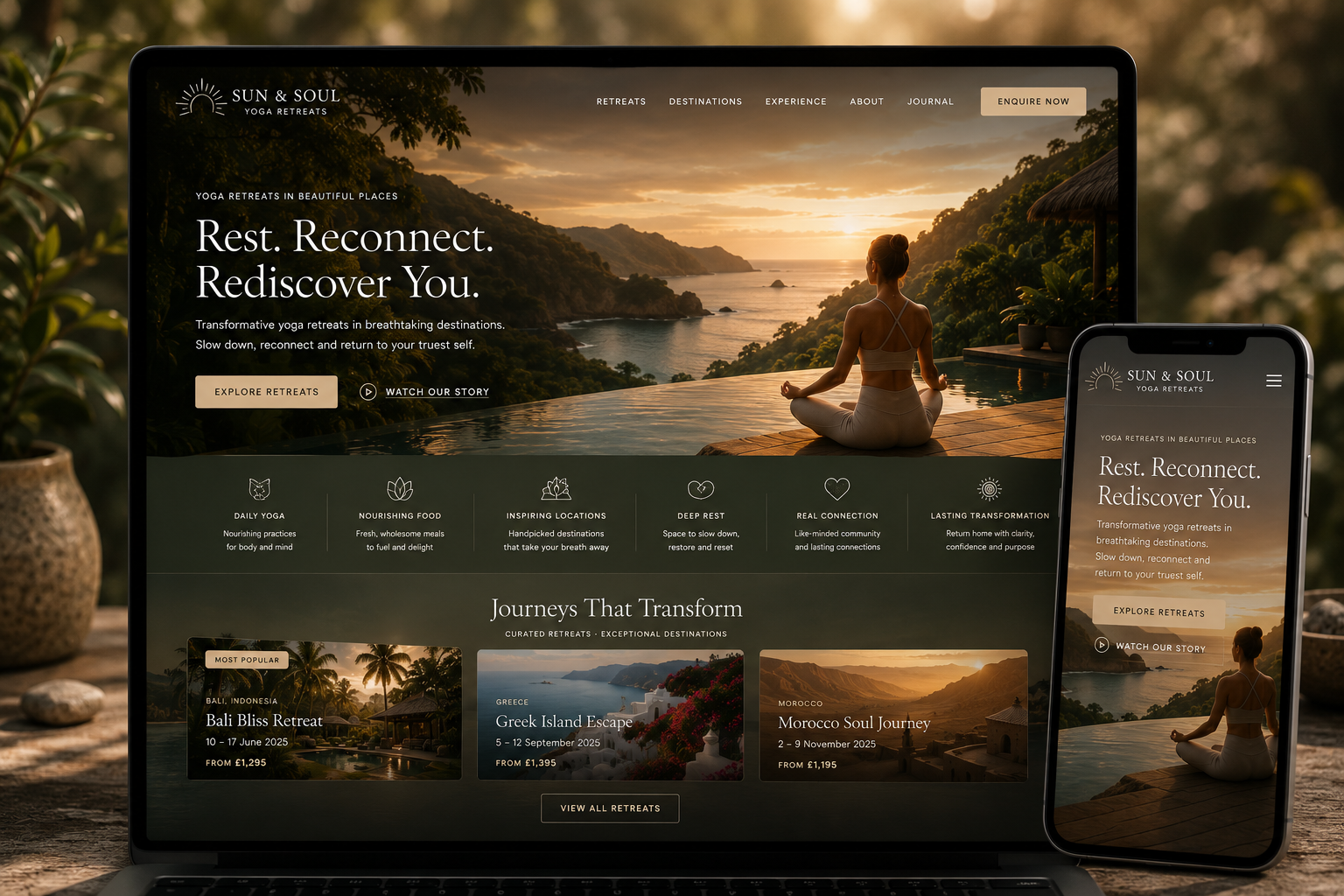
Not more decoration. A clearer story.
A basic retreat page often contains all the raw ingredients: a date, a location, a few photographs and a contact address. Yet the visitor may still struggle to picture the experience or judge whether it is right for them.
A stronger page introduces the destination, explains the teaching and daily rhythm, shows the accommodation, presents the investment honestly and invites questions at natural moments. Each section answers a different part of the decision.
The difference is not simply visual. It is editorial: deciding what to say, in what order and with what level of detail. The images shown here are design illustrations, not documented results from a measured client redesign.
Help the right people find your retreat.
A beautiful retreat page can also be structured to support discovery through Google. That means understanding how people search: sometimes by destination, sometimes by yoga style, duration, season or the type of experience they hope to have.
The strongest approach is to match each page to a meaningful search intent, then make its content genuinely useful. A retreat in a specific location should describe that location accurately. A specialist retreat should explain the practices, who it suits and what participants can expect.
Search visibility is not guaranteed, and no responsible designer can promise rankings. But clear pages, sensible internal links, useful information, good mobile performance and strong technical foundations give search engines and prospective guests a better chance of understanding your offer.
Destination-led searches
Create useful location context, travel information and locally relevant details for real retreat destinations.
Experience-led searches
Describe the yoga styles, workshops, pace and audience naturally, without repeating keywords for their own sake.
Evergreen visibility
Connect seasonal retreat pages to a stable retreat hub, your teaching story and relevant resources.
For a deeper explanation of Google visibility, AI-assisted discovery and content architecture, explore my Yoga SEO service or read my article on Google versus AI search.
The first glimpse may be on a phone.
Someone may discover your retreat during a commute, while scrolling in the evening or after a recommendation from a friend. They might open the page on a phone, save it, then return later on a laptop to consider the details.
The mobile experience therefore needs the same care as the desktop presentation. Images must retain their impact without obscuring text. Pricing and inclusions should remain readable. Enquiry buttons should be easy to find and use.
I build responsive WordPress layouts that aim to make those transitions feel natural, while keeping the site content manageable after launch. The goal is a website that feels as confident on a small screen as it does on a large one.
One approach does not fit every retreat.
A one-off weekend led by a single teacher has different needs from a multi-destination retreat company. Some hosts need one persuasive landing page. Others need a flexible system for dates, destinations, teachers and recurring programmes.
I design around the way you actually operate, rather than introducing complexity for its own sake.
A single signature retreat
A focused landing page with a strong story, clear dates, inclusions, FAQs and one comfortable enquiry route.
Seasonal retreat programmes
An overview page and individual retreat pages that make it easy to compare destinations, dates and availability.
Retreats within a teaching brand
A connected experience linking your retreat to your classes, workshops, story and existing community.
International retreat brands
Destination-led navigation, travel guidance and practical information for guests coming from different countries.
Private or bespoke retreats
A more personal, consultative journey for groups, corporate wellbeing experiences or custom programmes.
Recurring retreats
A structure that can be updated for new dates without rebuilding the whole website each season.
Promise an experience you can genuinely deliver.
Retreats can be meaningful, memorable and deeply restorative for many people. But a credible website should not promise that every guest will leave transformed, healed or changed forever.
I prefer writing that describes the actual practices, environment and opportunities for reflection, while leaving room for each individual experience to be their own. This approach feels more human, more respectful and ultimately more trustworthy.
The most compelling retreat brands rarely need exaggerated claims. Their atmosphere, teaching, hospitality and clarity can speak for themselves.
A thoughtful process, from first conversation to launch.
I work directly with you, beginning with the experience you want to offer and the questions your guests are most likely to ask. We look at what already exists, what needs improving and what a new visitor should understand within the first few moments.
From there, I shape the page structure, messaging and visual direction, then build the WordPress experience around clear enquiry pathways. Your own photographs, details and authentic voice remain central throughout.
01 · Discover
We discuss your retreat, guests, destination, teaching, existing website and priorities.
02 · Shape
I organise the story, page sections, key information, imagery and calls to action.
03 · Design & build
I create the responsive website, refine the visual experience and connect the enquiry journey.
04 · Review & launch
We check content, links, mobile presentation and essential details before publishing.
05 · Improve
After launch, we can review what visitors ask, where clarity is needed and what deserves refinement.
06 · Grow
As your programme evolves, the website can expand to new retreats, destinations and content.
Yoga retreat website FAQs
Some of the practical questions worth answering before we begin.
Can you build a website for just one retreat?
Yes. A single retreat can have its own carefully structured landing page, with atmosphere, itinerary, accommodation, pricing, questions and an enquiry route.
Can you redesign an existing retreat website?
Yes. We can retain what already works while improving the page hierarchy, visual presentation, copy and mobile experience.
Can the site include different dates and destinations?
Yes. We can create a retreat overview and individual pages for each programme, keeping navigation and updates manageable.
Can guests pay deposits or book online?
Depending on your preferred system, the website can link to an existing booking provider or be designed around an appropriate payment or enquiry flow. We would agree the setup before building.
Do I need professional photography?
Professional images can make a meaningful difference, but authentic, well-chosen photographs are often more useful than generic stock imagery. We can assess what you already have.
Can you help with writing the retreat descriptions?
Yes. I can help structure and refine the copy using accurate information about your retreat, teachers, accommodation and policies.
Will the website help with Google search?
I can build sound on-page SEO foundations and connect the retreat with relevant site content. Rankings and traffic depend on many factors and cannot be guaranteed.
Can you create a website for an international audience?
Yes. We can plan clear travel information, currencies, time zones and relevant practical details for guests travelling from different countries.
Will I be able to update the site?
The WordPress build can be organised for ongoing content updates, with the scope of editing access and support agreed for your project.
How do we get started?
Send me a short email or WhatsApp message about the retreat, its destination and dates, and whether you have an existing website. Your message comes directly to me.
Your retreat belongs to a wider story.
A retreat may be the centre of your business or one expression of a broader teaching practice. Your website should make those relationships clear, helping visitors discover your other offerings without distracting from the retreat itself.
Websites for yoga teachers
Introduce your teaching approach, regular classes and workshops. Explore teacher websites.
Yoga studio websites
Connect retreat programmes to your studio community and class timetable. Explore studio websites.
Yoga SEO
Develop search-friendly page architecture and useful content. Explore yoga SEO.
Give your retreat a website worthy of the experience.
Tell me where you are taking people, what you hope they will experience and what your current website is missing. Your enquiry comes directly to me, Liam, and I will reply personally.