
A specialist guide to digital visibility
Be Discovered. Be Understood. Be Chosen.
Yoga SEO for teachers, studios and retreats who have something meaningful to offer the world. A considered approach to Google visibility, local discovery and AI-assisted search – so the right students can find a practice that feels like theirs.
Beautiful design is only part of the story. Your website also needs to explain what you teach, who you help, where you work and why someone should trust you.
The moment before a new beginning
Somewhere, someone is searching for exactly what you teach.
They may not know your name. They may not even know which style of yoga they need. They know only that something in their life is asking for more space, more movement, more stillness, or a different way of feeling.
Your work could be the answer. But first, they have to find you. Then they have to recognise themselves in what they find.
Beyond the search result
Visibility is the invitation. Trust is what opens the door.
Think of the last time you considered entering an unfamiliar space. Perhaps it was a studio in a new city, a workshop with a teacher you had never met, or a retreat that promised a few days away from ordinary life. Before you committed, you looked for signals. Was it welcoming? Would you belong? Did the person behind it seem real?
Search engine optimisation is often presented as a technical race for position. But a position alone cannot answer these questions. The page must carry a sense of place and person. It needs to show what happens inside the room, what a newcomer can expect, and why this experience is worth choosing over the many alternatives.
For a yoga business, this is where search visibility, brand identity and conversion meet. Your website should feel unmistakably yours while remaining structured enough for search engines to understand.
That is why I do not separate SEO from thoughtful yoga website design. A website that is found but not believed has unfinished work to do.
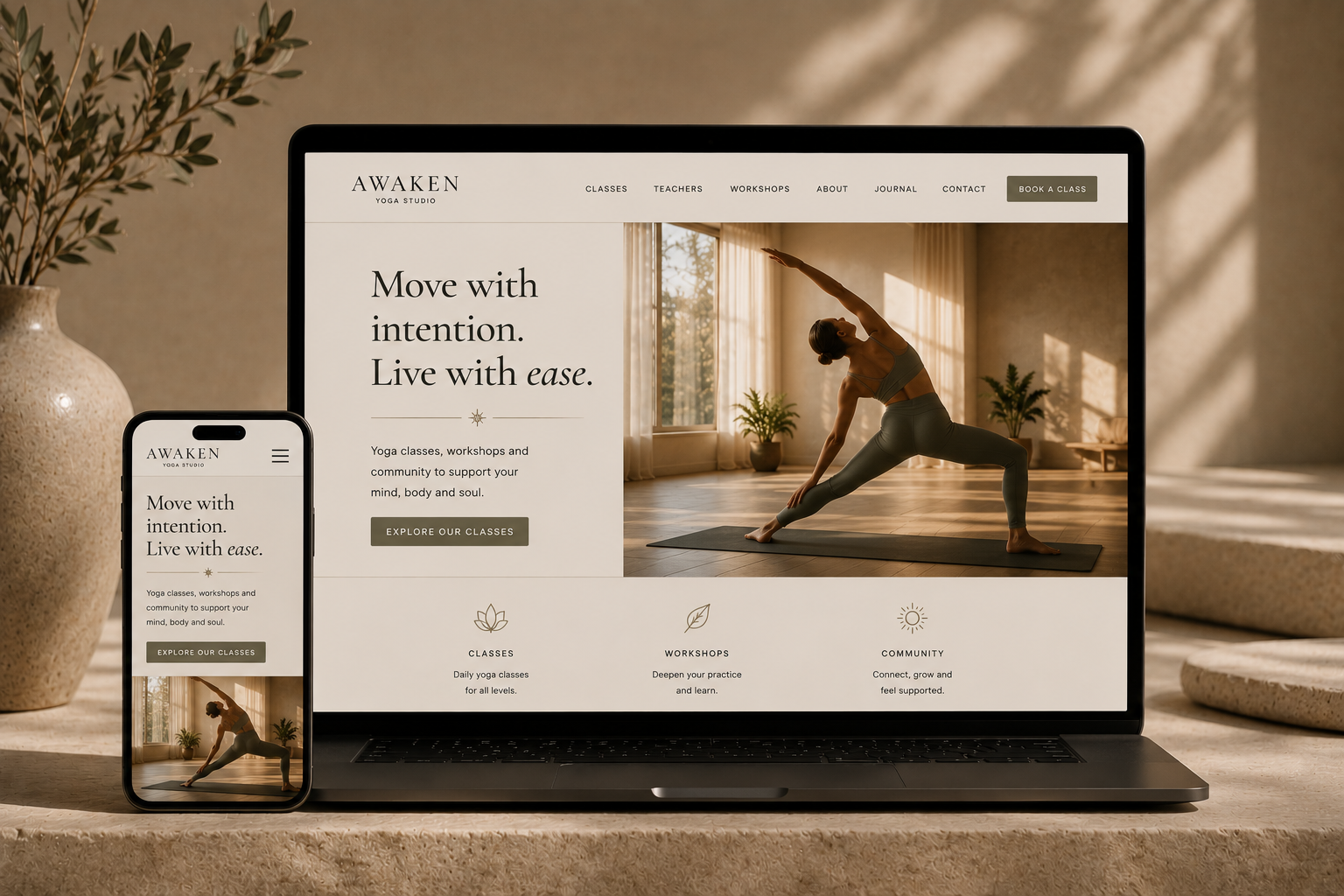 The first impression matters
The bigger picture
Search visibility is not the same as simply ranking for a keyword.
Imagine a prospective student who has never attended a yoga class. They might search for “beginner yoga classes near me”, ask a friend for a recommendation, look at studio reviews on Google Maps or ask an AI assistant which local classes would suit someone nervous about their first session. Each journey starts differently, but the underlying question is similar: where can I find an experience that feels right for me?
Your website needs to be discoverable, certainly. But it must also make your teaching understandable and give visitors confidence in the next step. A page that attracts visitors but leaves them uncertain about class levels, locations, prices or booking options has only solved half the problem.
This is why my approach to yoga web design and search visibility is connected. The design creates a first impression; the words, page structure, genuine evidence and practical information make that impression useful. Neither should work against the other.
The changing search landscape
From a list of websites to a conversation about what to choose.
For many years, a search for yoga classes usually began with a short phrase and a results page. Today, people may still use conventional Google results, but they can also encounter map listings, AI Overviews, social recommendations and assistants that help compare options. These experiences overlap rather than replacing one another.
Consider the difference between “yoga studio Bristol” and “I am a complete beginner in Bristol, want a gentle evening class and would prefer a small group with a friendly teacher.” The second request contains the real concerns behind the search. An AI-assisted service may attempt to interpret those preferences, but it can only work with information it can access and assess, and it may still get things wrong.
In my longer article, The Search Revolution: Why Your Website Must Speak to Humans and Machines, I explore why businesses need to be understandable to both human visitors and machine-assisted discovery systems. The lesson for yoga businesses is practical: explain your classes, your approach and your credibility in language that does not force anyone to guess.
No responsible SEO provider can promise a particular Google position or guarantee that ChatGPT or another AI system will recommend your studio. The aim is to make accurate, useful information easier to discover, interpret and trust.
Location, class pages, map visibility and clear booking information.
Detailed class descriptions, beginner reassurance, credible teaching information and context.
A necessary distinction
Google SEO and AI search are related, but they are not identical.
Google Search discovers and indexes pages, evaluates relevance and presents results in several formats, including local listings and AI-generated features. AI assistants can generate answers from learned patterns and, when equipped with retrieval, may consult live sources. Not every AI answer is based on a fresh web search, and not every answer is accurate.
For your yoga business, the sensible response is not to create a secret “AI version” of your website. It is to make important facts available in accessible text, logical HTML and well-connected pages. Describe the classes you genuinely offer, the qualifications you actually hold, your location or online availability, how bookings work and the people you serve.
Appropriate structured data can add context, but it cannot substitute for clear visible content. There is no magic schema setting or special file that guarantees inclusion in AI answers. Strong foundations are more valuable than chasing a fashionable shortcut.
The practical foundations
What a serious yoga SEO strategy actually includes.
Different businesses need different priorities. These are the core areas I would assess before recommending ongoing SEO work.
Search intent and research
Identify the questions prospective students actually ask, then separate informational searches from searches made by people ready to book.
Distinct service pages
Give genuinely different offers their own useful explanations: classes, private yoga, teacher training, retreats or online memberships.
Local visibility
For eligible studios and in-person teachers, improve location information, Google Business Profile completeness and relevant local landing pages.
Technical foundations
Check indexing, canonical URLs, redirects, crawl access, sitemap, page speed, mobile usability and broken links.
Useful internal links
Connect related pages so students and search systems can move from broad information to specific classes and booking options.
Credibility and evidence
Show real teacher profiles, honest qualifications, original photography, authentic reviews and clear contact details.
Local yoga SEO
Help nearby students find a real place to practise.
For a physical studio, local visibility often matters more than attracting visitors from the other side of the world. Someone searching for a Tuesday evening yoga class wants to know where the studio is, whether the timetable works for them and whether they can get there easily. A beautiful homepage without a clear address, schedule or directions can lose that opportunity.
An eligible Google Business Profile can help people find accurate opening information, photographs, directions, reviews and a route to your website. Categories, service details and business information should reflect the real business. A teacher operating without a qualifying physical or service-area business should not invent an address merely to appear in local maps.
Your location pages should be genuinely useful. A yoga studio in Manchester might explain its neighbourhood, public transport, parking, accessibility and the classes offered at that site. Publishing dozens of near-identical pages with swapped town names is unlikely to create the same value.
Local SEO also depends on consistency. If your timetable, address or booking link changes, the website and important external profiles should be updated together. Conflicting details make the decision harder for students and can confuse discovery systems.
For independent teachers
Build visibility around the person, not just the class.
An independent teacher may teach in several venues, offer private sessions and host occasional workshops. Their SEO strategy should not pretend they operate a large permanent studio. Instead, the website should explain the teaching approach, suitable experience levels, real class locations and how to enquire about private work.
A useful website for a yoga teacher can include an introduction, qualifications presented accurately, an approachable account of what students can expect, and clear pages for distinct services. If you specialise in restorative yoga, pregnancy yoga or one-to-one sessions, those differences deserve careful explanation rather than a list of keywords.
The goal is not to rank for every style of yoga. It is to attract students who are a good fit for what you genuinely teach, and to help them feel informed before they contact you.
For studios
Connect class discovery to a booking that feels effortless.
A yoga studio website has a different information problem. Visitors may want to compare class styles, teachers, levels, times and prices before making a decision. If those details are spread across social posts or hidden behind a difficult booking interface, potential students may leave.
Good studio SEO supports useful class pages and local discovery, while design supports the next step. A clear timetable, a first-visit guide, teacher introductions and a transparent explanation of memberships can remove friction that keywords alone cannot address.
Where the studio runs multiple locations, each genuine location may need its own useful information. Where it runs one location, clarity and depth on that location are more valuable than artificial geographic expansion.
For retreats and online teaching
Not every yoga search is local.
A retreat guest may be searching by destination, date, yoga style, accommodation or the kind of experience they hope to have. A retreat website should answer the practical questions: who hosts it, where it takes place, what is included, what is not included, the itinerary, price and cancellation terms. Original photography and transparent information matter enormously.
An online yoga business may instead need to explain time zones, live versus recorded sessions, membership options, class access and whether content is suitable for beginners. It should be clear which offers are available internationally and which depend on location.
For both models, useful specialist pages can be more valuable than generic wellness articles. A retreat itinerary and a transparent “what to expect” guide can help people evaluate a real purchase, not simply attract casual traffic.
An illustrative site architecture
One yoga business. Several clear pathways.
This is a planning example for a studio that also offers workshops and online classes, not a recommendation to create every page for every business. Each page should exist because it serves a real offer or question.
Every branch should connect back to relevant offers and real evidence. Clear navigation helps people and crawlers; it does not require hundreds of thin pages.
Avoiding cannibalisation
More pages are not automatically better pages.
If two pages target the same search intent with nearly identical wording, they can make it harder to decide which URL is the best result. That is why I plan a primary purpose for each page rather than making every heading compete for the same broad phrase.
For example, a studio homepage can introduce the whole business, while a beginner-class page answers beginner-specific questions. A retreat page explains a particular experience, while an article about preparing for your first retreat answers an informational question. These are complementary roles.
The same discipline guides this website. The Yoga Web Designer homepage focuses on yoga web design; this page focuses on yoga SEO. They are related services, but they should not be written as duplicates.
Content with purpose
Stop publishing for a word count. Start answering better questions.
A useful yoga content strategy starts with real conversations. What do nervous beginners ask before attending? How should someone choose between a gentle class and a stronger flow? What should retreat guests pack? What happens at a private yoga consultation? Which questions recur in your email inbox?
Answers to these questions can become helpful pages or sections when they add genuine value. They should be grounded in your actual teaching and reviewed for accuracy. A hundred thin articles produced only to target keyword variations are not a substitute for a smaller body of original, useful material.
Helpful content also needs a route to action. An article explaining what to expect at a beginner class might naturally link to the beginner timetable and first-visit information. An article about retreat preparation might link to a specific upcoming retreat. The link should help the reader, not exist merely for SEO.
For a practical example of how helpful content can support a business beyond social media, read why Instagram alone is not enough for a yoga business. It explains how an owned website brings teaching information, trust and enquiries together.
For health-related claims, avoid promises that yoga will cure medical conditions. Describe teaching approaches and intended experiences carefully, and distinguish general wellbeing information from professional medical advice.
Technical SEO, explained
The less glamorous details that make everything else possible.
Before publishing more content, I would check whether the important pages can actually be indexed. An accidental noindex setting, an incorrect canonical URL, blocked resources or broken redirects can undermine otherwise excellent work. XML sitemaps and Search Console can help diagnose visibility, but neither guarantees rankings.
Mobile usability matters because many people discover yoga businesses on their phones. Text should remain readable, controls should be easy to use, images should be sensibly sized and important information should not depend on a fragile animation. Core Web Vitals can help diagnose loading and interaction issues, but performance is only one part of a much wider search system.
Structured data may help clarify the business, people, articles, breadcrumbs or other supported content where appropriate. It must match the visible page and comply with search-engine guidelines. I would never add fabricated review ratings or qualifications just to produce a richer-looking search result.
The best technical work is often invisible to visitors. They simply arrive on a page that loads properly, explains itself, works on their device and lets them book.
Trust is not a plugin
A review is useful because a real person wrote it.
Genuine student reviews, teacher credentials, original studio photographs and clear policies help people assess whether a yoga business is right for them. They may also provide useful context across external discovery platforms, depending on the system and query.
They cannot be manufactured responsibly. I would rather show three authentic reviews than thirty invented ones, and I would rather describe a teacher’s actual experience than exaggerate a qualification. For SEO and conversion, accuracy is a long-term asset.
Measurement and expectations
What should you actually measure?
Rankings are one signal, but they are not the final business outcome. A yoga studio may care more about qualified timetable visits and trial-class bookings. A retreat organiser may value well-matched enquiries. An independent teacher may want a sustainable number of private-session enquiries.
Google Search Console can show search queries, impressions, clicks and pages receiving organic visibility. Analytics, where appropriately configured with privacy and consent requirements, can help show what visitors do after arriving. Booking-system reporting and enquiry records can complete the picture.
An SEO programme should establish a sensible baseline, identify a limited number of meaningful improvements and review results over time. Some changes can be assessed quickly; competitive searches may take considerably longer. No ethical provider should guarantee first place, a fixed number of students or inclusion in AI recommendations.
It is also important to distinguish correlation from cause. If bookings improve after a redesign, seasonality, pricing, referrals and marketing activity may also have contributed. We should use evidence to guide decisions rather than invent a success story.
A considered working method
How I would approach your yoga SEO.
Not every project needs a large monthly retainer. The first step is understanding the existing website and the opportunity.
Understand the business
Review your teaching offers, ideal students, current website, booking process, geographic reach and what success would mean.
Audit visibility
Check indexing, search queries, page structure, local profiles where relevant, mobile usability and obvious technical issues.
Prioritise improvements
Identify the most useful changes: clearer service pages, better internal links, local details, stronger content or technical repairs.
Build and refine
Implement agreed improvements with design and messaging considered together, preserving what already works.
Measure and learn
Review meaningful search and enquiry indicators, then refine the plan without promising predetermined results.
Keep it manageable
Choose focused one-off improvements or ongoing support according to the work actually required.
About the approach
The thinking behind the work.
I’m Liam O’Neill, the designer behind Yoga Web Designer. My wider work combines website design, SEO and digital visibility, and I believe the most useful websites are both persuasive to people and understandable to search systems.
On my detailed Google versus AI search article, I explain the broader shift using examples from several industries. Here, the same principles are applied to yoga businesses: clear offers, trustworthy information, sensible site architecture and an experience that makes the next step easier.
If you are planning a new website, you may also want to explore my specialist yoga web design service. If you already have a website, we can start by identifying what needs improving rather than assuming a complete rebuild is necessary.
A different kind of competition
You are not competing to be the loudest. You are competing to be understood.
There will always be bigger studios, larger marketing budgets and websites publishing more articles. Your advantage may be something harder to copy: the character of your teaching, the atmosphere of your classes, the trust you have earned, and the way you make people feel welcome.
Good yoga SEO gives those qualities a clearer expression. It does not flatten your identity into a list of search terms.
A student’s journey
Four quiet decisions happen before somebody books.
A prospective student rarely moves straight from an unfamiliar search result to a paid class. They move through a sequence of small judgements. The search listing earns a glance. The landing page earns a few seconds. The details earn confidence. The booking process makes action possible.
Discover
Relevant search results, maps and referrals make your business visible at the moment of interest.
Recognise
Clear descriptions help a visitor understand whether your teaching suits their needs and experience.
Trust
Authentic photographs, teacher biographies, practical answers and genuine reviews reduce uncertainty.
Begin
A simple timetable, honest pricing and accessible booking route make the next step feel natural.
Every stage can break. An attractive page with no clear timetable may lose a student at the last moment. A technically optimised page with vague copy may never earn trust. A brilliant teacher with no useful information online may remain invisible to the very people who would value their work most.
The purpose of a joined-up SEO strategy is to notice these gaps and address them in the right order. More traffic is not always the answer. Sometimes the more valuable change is helping existing visitors understand your classes and make an informed decision.
Illustrative search experience
Learn what to expect, see the class level, find the studio and view the timetable.
Meet the teacher, understand their approach and read genuine student experiences.
Clear availability, pricing and what to bring – without unnecessary friction.
Conceptual example, not an actual Google result or ranking claim.
Search intent in practice
The same person can make three very different searches.
“What is restorative yoga?” is a request for understanding. “Restorative yoga classes in Bristol” suggests a search for options. “Book restorative yoga Tuesday evening” suggests that someone may be ready to act. These searches deserve different kinds of answers, even when they are made by the same person.
For the first, a clear educational explanation may be appropriate. For the second, a genuinely relevant class page with location, teacher and timetable information is more useful. For the third, the booking path should be unmistakable.
This is what keyword research is really for. It is not simply a list of phrases with monthly search volumes. It is a way of understanding what people need at different moments, and of deciding which page should serve each need.
Forcing every phrase onto one homepage usually makes the experience worse. Building dozens of near-identical pages can be equally unhelpful. The right structure is deliberate: each important page has a job, and related pages support one another.
The architecture of relevance
Build a website that reads like a considered conversation.
Imagine opening a beautifully designed yoga website and finding only a poetic welcome, a handful of photographs and a button that says “Explore”. You might love the atmosphere, but still have no idea whether there are classes near you, whether beginners are welcome or how much a private session costs. Search engines face a similar problem when the website leaves essential facts unstated.
A clear site architecture gives each offer room to breathe. A studio homepage can introduce the practice and location. Class pages can describe different styles and levels. Teacher profiles can establish experience and personality. A retreat page can explain the destination, dates, accommodation, itinerary and terms. The contact and booking journey can then bring everything together.
Internal links are the quiet connective tissue. A beginner class page can point to a useful “what to expect” guide. A teacher biography can link to the classes they actually teach. A retreat overview can lead to a full programme. These links help visitors navigate and help search systems discover related information.
Good architecture also prevents keyword cannibalisation. If two pages are trying to satisfy the same query with nearly identical content, neither necessarily provides a clear answer. I would rather create one excellent, purposeful page than several weak pages competing with one another.
The result should feel less like a filing cabinet and more like a guided introduction: enough information to be useful, enough breathing room to remain beautiful, and a logical next step whenever someone is ready.
Google, AI and the changing discovery journey
When search becomes a conversation, clarity becomes a competitive advantage.
Traditional search often begins with fragments: “yoga studio Manchester”, “kundalini yoga online”, “weekend yoga retreat”. Conversational search can begin with a more complicated need: “I am completely new to yoga, work late and want a small, welcoming class near my office. What should I look for?”
The second question contains more context. A helpful website can make that context easier to assess by clearly explaining class sizes, beginner suitability, schedules, accessibility, teaching style and location. Those details help humans immediately; they may also be useful to search and retrieval systems that can access the page.
However, AI assistants do not all work in the same way. Some answers rely on retrieved web content; others do not. Information can be incomplete or misinterpreted. There is no reliable trick that forces a model to mention a particular studio, and no responsible provider can promise inclusion.
My article Google vs AI Search: the changing rules of digital visibility explores this wider shift. The practical lesson for yoga businesses is not to abandon Google SEO. It is to create a stronger information foundation that makes sense across different discovery experiences.
Two ways of asking
A relevant studio location page, maps information, classes and opening details.
Useful descriptions of class level, atmosphere, timing, instructor and how a first visit works.
Illustrative queries; not a prediction of AI recommendations.
The human side of local SEO
People do not attend a search result. They travel to a real place.
Local yoga SEO should be grounded in the actual experience of reaching and attending your classes. Someone may be searching on a bus after work, walking through a new neighbourhood or planning their first free Saturday morning in months. They need more than a town name in a heading. They need to know which entrance to use, whether parking is available, how far the venue is from public transport and whether the class really happens at the advertised time.
For eligible businesses, an accurate Google Business Profile can help people find the location, contact information, photographs and reviews. A useful website supports that profile with fuller context: the timetable, class descriptions, pricing, teachers and policies that cannot always fit into a short listing.
Location pages should reflect genuine locations and genuinely different experiences. Creating a series of interchangeable “yoga in [town]” pages for places you do not serve is not a credible long-term strategy. If you teach at several real venues, explain each one accurately. If you operate from a single studio, invest in describing that studio well.
Photos matter here because they remove uncertainty. An image of the actual room can tell a first-time student more than a generic photograph of a person practising yoga on a beach. The best visual evidence is recognisable, truthful and useful: the entrance, the teaching space, the instructor, the mats, the natural light, the small details that make arrival feel less intimidating.
And when the business receives genuine feedback, respond thoughtfully. Reviews are not only marketing assets. They can reveal the words students use to describe the experience, the reasons they return and the concerns new students may share.
Editorial content with a purpose
Write for the questions that stand between curiosity and commitment.
A yoga blog should not exist merely to prove that the website is active. Endless generic articles about the benefits of yoga may attract broad, poorly matched traffic while doing little for bookings. The more useful editorial question is: what does a prospective student need to know before they feel comfortable choosing this teacher or class?
For a beginner-focused studio, that might mean a thoughtful guide to the first class: what to wear, what to bring, whether flexibility matters, what happens if someone needs a break and how the instructor supports different abilities. For a teacher offering private sessions, it may mean explaining how a one-to-one session is structured and who it might suit.
For retreats, useful content may address travel, accommodation, meal arrangements, daily rhythms, group size, suitability and cancellation terms. For online teaching, it may explain the difference between live sessions and recordings, what equipment is needed and how members access their classes.
These topics can support search visibility because they answer real questions. They also reduce repetitive enquiries and help people self-select. Someone who reads an honest explanation and decides a particular class is not right for them has still benefited from a useful website. The goal is better-fit students, not merely more clicks.
When discussing health or wellbeing, the language must remain responsible. Yoga teachers should not imply that classes cure medical conditions unless claims are appropriately supported and within their professional scope. Accurate descriptions of what a class involves are more trustworthy than sweeping promises.
The value of being specific
Not every visitor is your student. The right visitor might be.
Perhaps you teach slow, thoughtful classes for people who find large studios overwhelming. Perhaps you lead physically demanding workshops for experienced practitioners. Perhaps your retreats are intimate, carefully hosted journeys rather than crowded holidays.
The more clearly your website communicates that difference, the easier it becomes for someone to recognise a genuine fit. Search visibility should amplify your identity, not erase it.
Technical foundations, without the theatre
Make the beautiful experience reliable underneath.
Even a carefully written website can be held back by technical problems. Important pages might accidentally be set to noindex. A redesign might change URLs without redirects. A slow hero image might delay the moment a visitor can read the page. A mobile menu might cover the booking button. These are not glamorous issues, but they affect whether the site can be found and used.
A sensible technical review starts with crawlability and indexability, then checks canonical URLs, redirects, sitemap coverage, internal linking, image handling, accessibility and mobile interaction. Search Console can help identify how Google is discovering pages and whether particular URLs have indexing problems. It should be used diagnostically, not treated as a machine that guarantees results.
Performance improvements are most valuable when they improve the experience itself. Compressing oversized photographs, reserving space for images to reduce layout shifts and simplifying heavy scripts can make the site more comfortable to use, especially on a mobile connection. The aim is not to win a perfect synthetic score at the expense of visual character.
Structured data may help describe the organisation, people, articles and navigation where relevant and supported. It should represent what is actually visible on the website. It is not a substitute for useful content, and fabricated ratings or unsupported claims have no place in a credible strategy.
Accessibility deserves the same care. Readable contrast, logical headings, keyboard-accessible controls, descriptive links and clear forms are good for real people first. They also encourage disciplined structure and reduce the risk of visitors being excluded from the experience.
From attention to enquiries
More visitors will not help if the next step is invisible.
Picture a studio that has improved its search visibility. More people now arrive on its class pages. Yet bookings barely move. The problem may not be search at all. The timetable might be difficult to use on a phone. Prices might be hidden until the final step. Visitors might be unsure whether a class is suitable for beginners, or the booking system may demand too many decisions.
If visitors are finding your website but not taking the next step, my guide to five reasons a yoga website may be losing bookings explores common problems with clarity, mobile experience and booking journeys.
Conversion improvements begin with observation. Which pages attract visitors? Where do they go next? Which questions repeatedly arrive by email? Are people trying to book a class that is not actually available? The answers can suggest practical changes: a clearer call to action, a more direct timetable link, a concise beginner reassurance section or a better explanation of class levels.
Different businesses should measure different outcomes. For a studio, a first-class booking may matter most. For a retreat organiser, a well-qualified enquiry may be more valuable than a large number of casual visits. For a private teacher, a small number of suitable recurring clients may be the real goal.
Measurement should be transparent and proportionate. Search Console can show impressions and clicks; appropriately configured analytics can show useful site interactions; the booking platform and enquiry records can show what happened afterwards. None of these alone tells the whole story.
It is also important to distinguish revenue from profit and to avoid pretending that every booking came from SEO. Seasonality, referrals, promotions and word of mouth all influence outcomes. An honest review of performance is more useful than a dramatic but unsupported return-on-investment claim.
A realistic example
What could one additional regular student mean?
Consider a hypothetical studio charging £12 for a weekly class. If one additional student attends 40 paid classes across a year, that represents £480 in gross class revenue (40 × £12). Two such students would represent £960. This is an illustration of potential turnover, not a forecast, guarantee or calculation of profit.
For some businesses, the more meaningful improvement might be a higher-value retreat enquiry or a regular private student. The appropriate comparison depends on actual prices, attendance, capacity, retention and costs. I would rather use your real figures than make a dramatic claim about thousands of pounds in automatic returns.
The point is simple: a website should support the economics of the business behind it. That means attracting people who are likely to value your teaching, helping them make informed choices and removing unnecessary friction from the path to booking.
A sustainable approach
Build something worth finding, then keep it worth returning to.
Search visibility is not a single launch-day task. Class schedules change. Teachers join or leave. New workshops appear. Retreat dates pass. Links break. What once described your business accurately may become out of date, and that can undermine confidence just as easily as poor design.
A sustainable SEO programme begins with strong foundations and a realistic maintenance rhythm. Important pages should be reviewed when the offer changes. New content should be published because it is useful. Technical issues should be addressed when they arise. Search and enquiry data should inform decisions without dictating every word of the brand.
For some yoga businesses, a focused one-off project will be enough to resolve major weaknesses. Others may benefit from ongoing help because their classes, locations or offers change regularly. There is no reason to sell a large retainer simply because the phrase “SEO” sounds complicated.
Above all, the website should remain a faithful representation of the teaching. A student who arrives after reading your site should find the experience recognisable. The strongest marketing does not create a fantasy that the real class cannot fulfil. It sets an accurate expectation and lets the quality of the work speak for itself.
Practical answers
Yoga SEO questions, answered plainly.
Can SEO help a new yoga teacher get discovered?
It can help establish clear, indexable information about your teaching, services and genuine locations. Results depend on competition, website quality, relevance and time; a new site should not expect immediate top rankings.
Should my yoga studio have a Google Business Profile?
If your business meets Google’s eligibility rules, a complete and accurate profile can be useful for local discovery. Do not create a fake location or misleading business listing.
Will SEO help my yoga business appear in ChatGPT or other AI tools?
Clear, accessible and credible information may help discovery systems understand your business, but no one can guarantee a mention or recommendation. Different systems use different sources and may make mistakes.
Do I need a separate page for every yoga class?
Only when the class has enough distinct value and information to justify a dedicated page. A clear timetable and well-organised class descriptions may be better than many repetitive pages.
Can you work on my existing yoga website?
Yes. A focused content, structure or technical improvement may be more appropriate than a full redesign, depending on what the audit reveals.
How long does yoga SEO take?
There is no universal timetable. Technical corrections can be made quickly, while gaining visibility in competitive searches may take months or longer. The starting position and scope of work matter.
Do I need to publish a blog every week?
No. Publish when you have something genuinely useful to say. Accurate class information, service pages, FAQs and original evidence may be a higher priority.
Do you work with yoga businesses internationally?
Yes. I work remotely with English-speaking yoga businesses worldwide. Local SEO strategies will still need to reflect the actual country, service area and business model.
Can you guarantee more bookings?
No. SEO can improve the foundations for relevant discovery, but bookings depend on demand, competition, the offer, pricing and the experience after someone arrives.
Ready to be easier to find and easier to choose?
Build a yoga website that makes sense to people and search.
Tell me about your yoga business, your current website and the enquiries you want to attract. We’ll begin with what genuinely needs improving.